Key takeaways
- Match the lot number on the certificate to the lot number on the vial label before use.
- Read HPLC purity as an area percentage, and note the specification and the measured value separately.
- Confirm identity by comparing theoretical and observed mass within the stated tolerance.
- Save the certificate file named by lot number alongside the order record.
- Treat the size in the product name as net content; courier weight is a packed weight.
What the certificate records
A certificate of analysis is a per-lot document that states the identity, quantity and purity of a peptide and names the method used to measure each. It is filed against the lot number printed on the vial label.
Every lot we sell carries a downloadable certificate of analysis with HPLC and mass-spectrometry data. Purchasing officers file that document with the order record. Principal investigators read it before the vial is opened for in vitro work.
The document is not a claim about use. It is a record of what was measured, when and by which method.
Header fields to check first
Start at the top of the page. Four fields matter before any chromatogram is read.
- Product name and sequence. The peptide named on the certificate must match the vial label.
- Lot number. This is the key that ties document to vial. If it does not match the label, the document belongs to another lot.
- Quantity per vial. Stated as net content, for example 5 mg or 10 mg. Shipping weight on the courier label is a packed weight and is a different number.
- Test date and analyst or laboratory. Our purity testing is third-party HPLC and mass spectrometry.
Record the lot number in your reagent log at intake. That single step makes later traceability straightforward.
Retention time on the HPLC trace
The HPLC section reports a chromatogram: a plot of detector signal against time. The main peak appears at a retention time, usually given in minutes to one or two decimal places.
Retention time is a property of the peptide under the stated conditions. The certificate should list those conditions: column chemistry and dimensions, mobile phase composition, gradient, flow rate, column temperature and detection wavelength. Change any one of them and the retention time moves. That is why the conditions are printed beside the number rather than left out.
Two things are worth reading on the trace itself. First, whether the main peak is symmetrical and resolved from its neighbours. Second, whether small peaks are labelled with their own retention times and areas. Those minor peaks are the remainder of the purity calculation.
Purity percentage and how it is calculated
Purity by HPLC is an area percentage. The area of the main peak is divided by the total area of all integrated peaks, then multiplied by 100. A line reading ≥98% by HPLC means the main peak accounted for at least that share of the integrated signal.
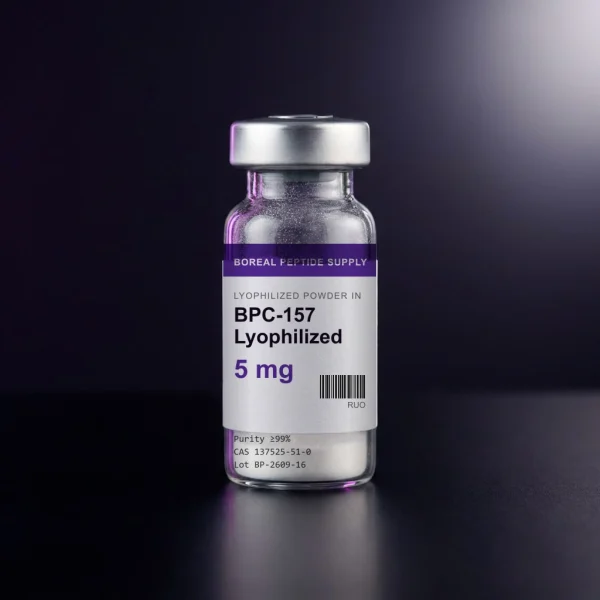
Read the specification and the measured value as two separate numbers. The specification is the threshold the lot had to meet. The measured value is what the lot returned. Our BPC-157 Lyophilized Powder is supplied in a 5 mg sealed glass vial. It is specified at ≥99% purity by HPLC. It is priced at $54.99 CAD.
Purity by HPLC is a chromatographic figure. It is not a mass balance. Water content, residual salts and counter-ions are not part of the peak area, so a lyophilized powder at ≥99% by HPLC still contains those components. If your protocol needs them quantified, ask for the relevant test by lot number before ordering.
The mass-spectrometry identity check
HPLC answers how much of the sample is one species. Mass spectrometry answers which species it is. The two lines are read together.
The certificate lists a theoretical monoisotopic or average mass, calculated from the sequence, and an observed mass from the instrument. Agreement within the stated tolerance supports the identity of the peptide. Many reports also show the charge state used, for example a singly or doubly protonated ion, because the instrument measures mass-to-charge rather than mass.
Work through it in order.
Step 1
Confirm the sequence on the certificate matches the peptide you ordered.
Step 2
Compare theoretical mass with observed mass. Note the difference.
Step 3
Check the difference sits inside the tolerance printed on the document.
Our Semax Heptapeptide is supplied as a 10 mg lyophilized vial at $52.99 CAD, specified at ≥99% HPLC purity. Our MOTS-c 16-Amino-Acid Peptide is a 10 mg lyophilized vial at $69.99 CAD. It is also specified at ≥99% HPLC purity. Longer sequences make the mass check more informative, because a single amino-acid substitution shifts the observed mass by a readable amount.
Filing the document against the lot
Download the certificate at the time of purchase and store it with the order number. Name the file with the lot number so it can be retrieved without opening it. Keep the vial label legible; the lot number on the label is the only link back to the document once packaging is discarded.
If an audit asks how a reagent was qualified, the answer is the certificate for that lot: identity by mass spectrometry, purity by HPLC, quantity per vial. Nothing else on the page substitutes for those three lines.
The full catalogue of Research Peptides is documented the same way, lot by lot. Bacteriostatic water and sterile 10 mL glass vials are listed under Lab Supplies.
Storage, documentation and scope
Store lyophilized peptide vials as directed on the label and keep them sealed until the lot is drawn for in vitro work. Retain the certificate of analysis for the life of the material and for as long as your records policy requires. Orders are quoted in Canadian dollars and shipped tracked. We sell to laboratories and qualified researchers only.
For laboratory research use only. Not for human or veterinary use.