Key takeaways
- A thawed cold pack on arrival is expected; the lyophilized state is the primary protection.
- Discard desiccant sachets at intake and keep vial seals intact.
- Log arrival date, item, quantity, lot number, purity method, storage location and condition.
- Download the certificate of analysis at intake and file it against the lot number.
- Store lyophilized vials in the freezer; keep bacteriostatic water and glass vials on a dry shelf.
What arrives in the parcel
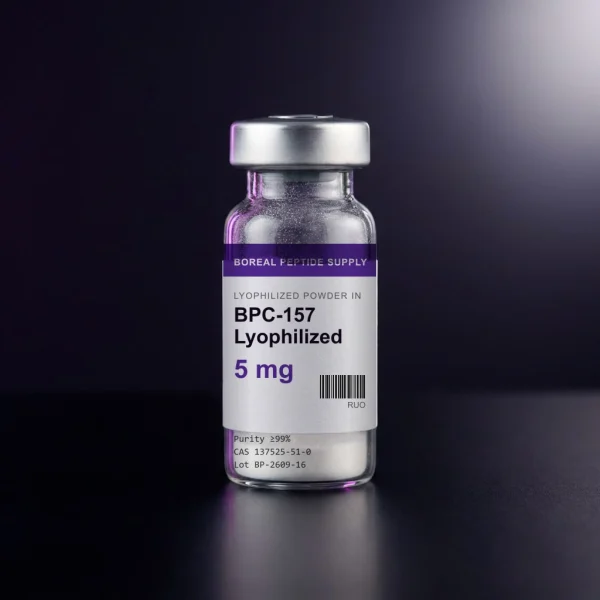
We supply BPC-157 Lyophilized Powder in 5 mg sealed glass vials, alongside sterile laboratory consumables. A shipment from Vancouver contains the ordered vials, a cold pack, desiccant sachets and a packing slip that carries the lot number for each item.
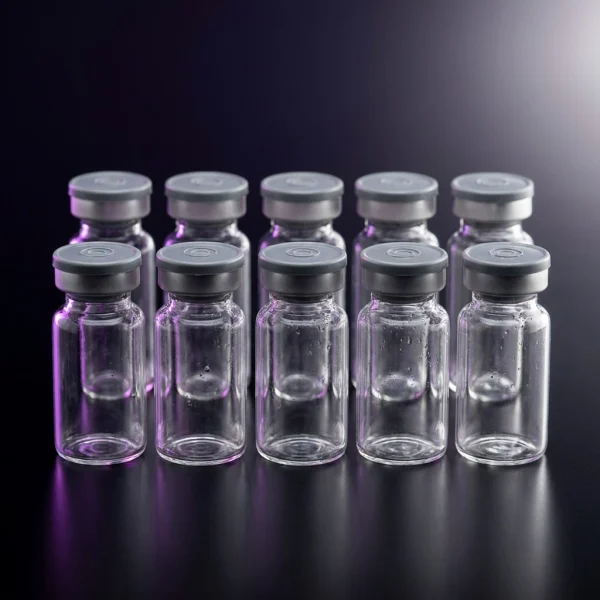
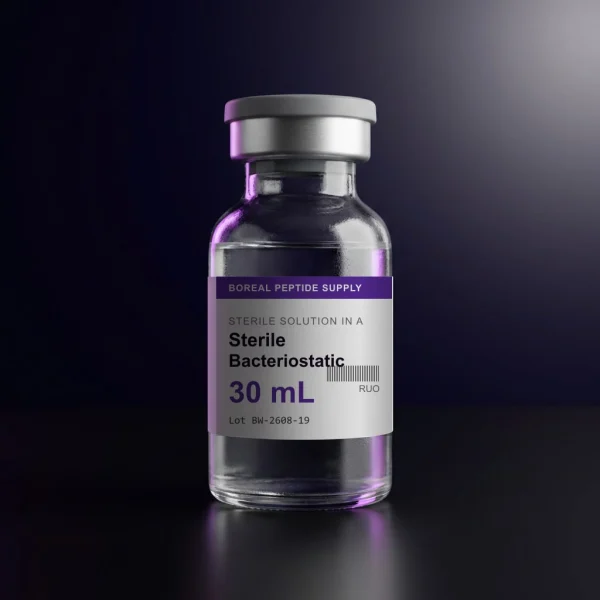
Peptide vials ship as lyophilized powder under crimped seals. The label on each vial states the peptide identity, the quantity in the vial and the lot number. Consumables such as Bacteriostatic Water 30 mL and Sterile Glass Vials 10 mL (pack of 10) travel in the same outer carton. Shipping is tracked.
How the cold pack works
The cold pack is a phase-change gel frozen before packing. It absorbs heat during transit and holds the interior of the carton below ambient temperature while it thaws. A thawed pack on arrival is expected. It indicates the pack performed its function over the transit window, not that the contents were mishandled.
Lyophilized peptides are stable in powder form at room temperature for short periods, which is why the material is shipped dry rather than frozen solid. The cold pack reduces thermal load; the lyophilized state is the primary protection.
What the desiccant does
Desiccant sachets sit alongside the vials inside the insulated liner. They adsorb water vapour that enters the carton as the cold pack thaws and the air inside warms. Lyophilized powder is hygroscopic, so limiting free moisture in the packaging matters more than cold alone.
The sachets are not part of the product and are not sterile. They are discarded at intake. The vial seals remain the barrier between the powder and the room.
Intake steps at the receiving bench
1. Inspect the outer carton
The receiving technician checks the carton for crush damage and confirms the tracking number against the courier record. Dimensions are modest — the BPC-157 carton measures 8×8×6 cm and the vial pack measures 16×10×7 cm — so a small parcel is normal.
2. Confirm counts against the packing slip
Vial counts, peptide identities and stated quantities are compared line by line with the packing slip. The pack of ten sterile vials is confirmed as ten individually wrapped units.
3. Read each label
Each peptide label is read for identity, quantity and lot number before the vial leaves the bench. Labels are not removed or overwritten.
4. Move material to storage
Vials are transferred to the assigned storage location and the location is written into the reagent log.
What to log at intake
A reagent log entry should be complete enough to reconstruct the shipment months later. Each field is recorded as a single fact.
- Arrival date. The date the parcel reached the laboratory.
- Item name and quantity. For example, BPC-157, 5 mg per vial.
- Lot number. Copied exactly from the vial label.
- Purity and method. BPC-157 is supplied at ≥99% purity by HPLC.
- Certificate of analysis. The file is downloaded and filed against the lot number.
- Storage location. Freezer, shelf and box identifier.
- Condition on arrival. Seal intact, desiccant present, cold pack state.
Purchasing officers who file documentation per lot should download the certificate of analysis at intake rather than at the point of use. The certificate carries HPLC and mass-spectrometry data for that lot.
Storage after intake
Storage conditions differ between the peptide vials and the consumables. The table below summarises common laboratory practice for lyophilized material and sterile water.
| Item | Form on arrival | Storage after intake |
|---|---|---|
| Peptide vials, 5 mg or 10 mg | Lyophilized powder, sealed | Freezer, sealed, protected from light and moisture |
| Bacteriostatic Water 30 mL | Sterile liquid, crimp seal | Room temperature, upright, out of direct light |
| Sterile Glass Vials 10 mL | Individually wrapped, sealed | Dry shelf, wrapping intact until use |
Vials should not be left at the receiving bench overnight. Shipping weights on the courier label — 0.05 kg for a peptide carton, 0.08 kg for the water vial, 0.3 kg for the vial pack — describe the packed parcel, not the net contents stated in each product name.
Ordering consumables with the peptide
Ordering consumables in the same parcel keeps a single tracking number and a single packing slip for the intake record. Bacteriostatic water is $14.99 CAD for the 30 mL multi-dose vial with 0.9% benzyl alcohol. The pack of ten clear borosilicate vials with butyl stoppers and flip-off aluminium seals is $24.99 CAD. BPC-157 in a 5 mg sealed glass vial is $54.99 CAD.
Further items are listed under /product-category/research-peptides/ and /product-category/lab-supplies/. All material is sold to laboratories and qualified researchers for in vitro work.
Each lot carries a downloadable certificate of analysis with HPLC and mass-spectrometry data, and the lot number appears on the label. For laboratory research use only. Not for human or veterinary use.